

The Real Question Behind This Comparison
If you have dealt with joint pain for any length of time, you have almost certainly come across glucosamine. It has been the default recommendation for joint health for over 30 years — sold in pharmacies, recommended by general practitioners, and taken by tens of millions of Americans every day.
So when a product like Joint Genesis comes along claiming to work through a fundamentally different mechanism — and to produce better results — the natural question is: is this genuinely different, or is it just marketing dressed up in new packaging?
We spent considerable time looking at the clinical literature for both approaches. What we found was more nuanced than either camp usually admits — and genuinely useful for anyone deciding where to spend their money.
Glucosamine tries to rebuild cartilage structure. Joint Genesis targets synovial fluid — the lubricating gel inside the joint. These are two entirely different mechanisms, and understanding that difference is the key to this whole comparison.
What Glucosamine Is — And What the Science Actually Shows
Glucosamine is a naturally occurring compound found in cartilage. As a supplement, it is typically derived from shellfish shells and sold as glucosamine sulphate or glucosamine hydrochloride. The theory behind it is logical: glucosamine is a building block of cartilage, so supplementing with it should help maintain or rebuild cartilage tissue.
The problem is that this logical theory has not translated cleanly into consistent clinical evidence.
What the Research Actually Found
The most rigorous trial ever conducted on glucosamine — the NIH-funded GAIT trial (Glucosamine/Chondroitin Arthritis Intervention Trial), which followed over 1,500 patients — found that glucosamine alone did not perform significantly better than placebo for the overall study population. A subgroup with moderate-to-severe pain did show some benefit, but the overall result was disappointing for a supplement that had been recommended for decades.
Subsequent meta-analyses have been similarly mixed — some showing modest benefits in certain populations, others showing effects indistinguishable from placebo when compared against high-quality controls.
Important context: This does not mean glucosamine is useless. Some people genuinely report meaningful benefit from it — particularly glucosamine sulphate at 1,500mg daily. The issue is that the evidence for it is inconsistent and the effect size, when present, tends to be modest.
Why It May Have Limitations
- Bioavailability is uncertain — glucosamine's oral bioavailability varies significantly between individuals, and it's unclear how much actually reaches joint tissue.
- Cartilage repair is slow — even if glucosamine does stimulate cartilage building, cartilage has no blood supply and heals extremely slowly. Expecting fast results is unrealistic.
- It doesn't address the fluid — glucosamine does nothing for synovial fluid, which is often the primary driver of friction, stiffness, and day-to-day discomfort in ageing joints.
- Not for shellfish allergy — most glucosamine is derived from shellfish shells, making it unsuitable for people with shellfish allergies.
How Joint Genesis Works Differently
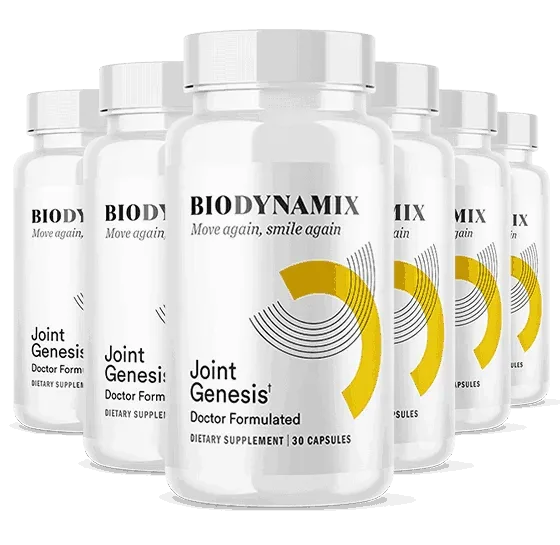
Joint Genesis takes a fundamentally different approach. Rather than targeting cartilage structure, it targets synovial fluid — the thick, gel-like lubricant inside every joint that is primarily composed of hyaluronic acid (hyaluronan).
As we age, hyaluronan production drops significantly. The synovial fluid thins. Joints that used to glide start grinding. The resulting friction causes both pain and accelerated cartilage wear. This is the mechanism Joint Genesis aims to address — restoring the lubricant rather than patching the structure.
The Role of Mobilee®
The centrepiece of Joint Genesis is Mobilee® — a patented, high-molecular-weight hyaluronic acid matrix developed in Spain. Unlike standard HA supplements, Mobilee® is a complex of hyaluronan, polysaccharides, and type I collagen engineered for superior bioavailability and synoviocyte stimulation.
Crucially, Mobilee® does not just supplement hyaluronic acid externally — it has been shown in clinical trials to stimulate the cells inside the joint (synoviocytes) to produce more of their own hyaluronan. This endogenous stimulation is what separates it from generic HA products.
Supporting this core ingredient are Boswellia serrata (anti-inflammatory, enzyme blocking), French Maritime Pine Bark (antioxidant, circulation), ginger root (COX-2 inhibition), and BioPerine® (bioavailability enhancement). The formula addresses both the lubrication deficit and the inflammatory environment simultaneously.
Head-to-Head Comparison
- Targets synovial fluid directly
- Patented Mobilee® (14+ clinical trials)
- Stimulates endogenous HA production
- Multi-mechanism formula (5 ingredients)
- Addresses inflammation simultaneously
- Shellfish-free, allergen-free
- 180-day money-back guarantee
- 1 capsule/day — simple to take
- Targets cartilage structure building
- Decades of use but mixed trial results
- Does not address synovial fluid
- Usually a single ingredient
- No anti-inflammatory action
- Often derived from shellfish
- Variable return policies by brand
- Often 2–3 capsules/day required
| Category | Joint Genesis | Glucosamine |
|---|---|---|
| Primary mechanism | Synovial fluid (HA restoration) | Cartilage building blocks |
| Clinical evidence quality | 14 RCTs for Mobilee® specifically | Mixed — GAIT trial inconclusive overall |
| Time to first results | 3–6 weeks typically | Often 2–3 months or longer |
| Addresses inflammation | Yes — Boswellia + ginger | No |
| Allergen safety | Shellfish-free, soy-free, gluten-free | Usually shellfish-derived |
| Daily dose | 1 capsule | 2–3 capsules typically |
| Price per month | ~$39–$69 depending on pack | ~$15–$30 for basic glucosamine |
| Money-back guarantee | 180 days — including empty bottles | Varies by brand, typically 30–60 days |
| Availability | Official website only | Pharmacy, Amazon, everywhere |
| Ingredient innovation | Patented, proprietary formula | Generic compound, 30+ years old |
Category-by-Category Scoring
Who Each Product Is Best Suited For
Choose Glucosamine if:
- You want the lowest possible monthly cost and are willing to accept modest, uncertain results
- Your doctor has specifically recommended glucosamine sulphate for your situation
- You are under 45 and dealing with minor cartilage-related issues rather than systemic joint stiffness
- You want something easily available at your local pharmacy without online ordering
Choose Joint Genesis if:
- You are over 40 and experiencing age-related morning stiffness, reduced mobility, or that "grinding" sensation
- You have already tried glucosamine for 3+ months without satisfactory results
- You have a shellfish allergy that rules out most glucosamine products
- You want a formula that addresses both lubrication and inflammation rather than one factor alone
- You are willing to commit to 90+ days and want a solid money-back guarantee as a safety net
Our Verdict
Bottom Line: Different Tools for Different Problems
Glucosamine and Joint Genesis are not really competing head-to-head — they target different aspects of joint health. Glucosamine works (when it works) by providing cartilage building blocks. Joint Genesis works by addressing synovial fluid — the joint lubricant that most people over 40 are quietly losing.
For the population most likely reading this comparison — adults over 40 with age-related joint stiffness and reduced mobility — the synovial fluid mechanism addressed by Joint Genesis is almost certainly more relevant than cartilage building blocks. The clinical evidence for Mobilee® is stronger, more specific, and more consistent than the evidence for glucosamine at this point.
Glucosamine's main genuine advantage is price. If budget is the primary concern, that matters. But given that Joint Genesis's 6-bottle package brings the cost down to $39/month, and given the 180-day money-back guarantee, the price gap is smaller than it first appears — and the potential upside is meaningfully greater.
Ready to Read Our Full Joint Genesis Breakdown?
Ingredients, clinical evidence, real user experience, pricing, and pros and cons — everything in one place.
Read Full Joint Genesis Review →Editorial review. Affiliate link present. Not medical advice.